How MCS Solar Installers Win More Local Customers
How MCS-Certified Solar Installers Can Win More Local Customers
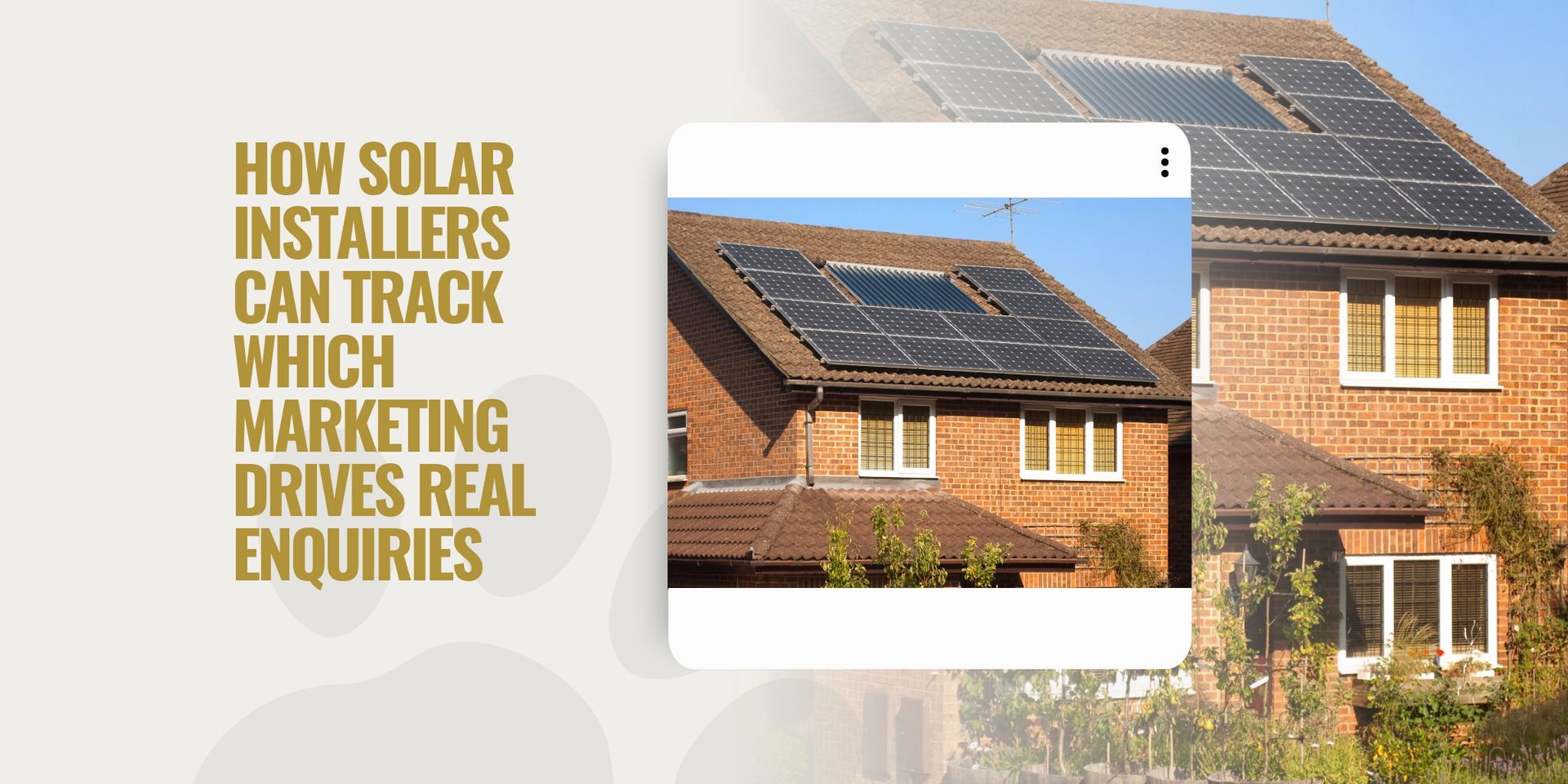
If you are an MCS-certified solar installer in the UK, the quality of your work is rarely the problem. The problem is that the right homeowners are not finding you.
Local visibility, trust signals, and a well-managed online presence are what separate busy installers from those waiting for the phone to ring.
This guide covers the practical steps you can take to attract more local customers, build lasting credibility, and convert more enquiries into confirmed bookings.
Why Local Visibility Is the Biggest Challenge for Solar Installers
Many MCS-certified solar businesses deliver excellent installation work but still struggle to be found online by homeowners who are actively searching for quotes.
The gap between doing great work and being visible in local search results is costing installers real revenue every single month. Improving your digital visibility does not require a large budget. It requires consistency, the right structure, and an understanding of how homeowners search.
According to the Microgeneration Certification Scheme, demand for certified solar installers across the UK continues to grow year on year.
Yet a significant number of certified businesses are losing enquiries to competitors simply because those competitors appear higher in search results. Being found online is now just as important as the quality of the installation itself.
What homeowners look for before choosing a solar installer
Before a homeowner picks up the phone or fills in a contact form, they typically research several installers.
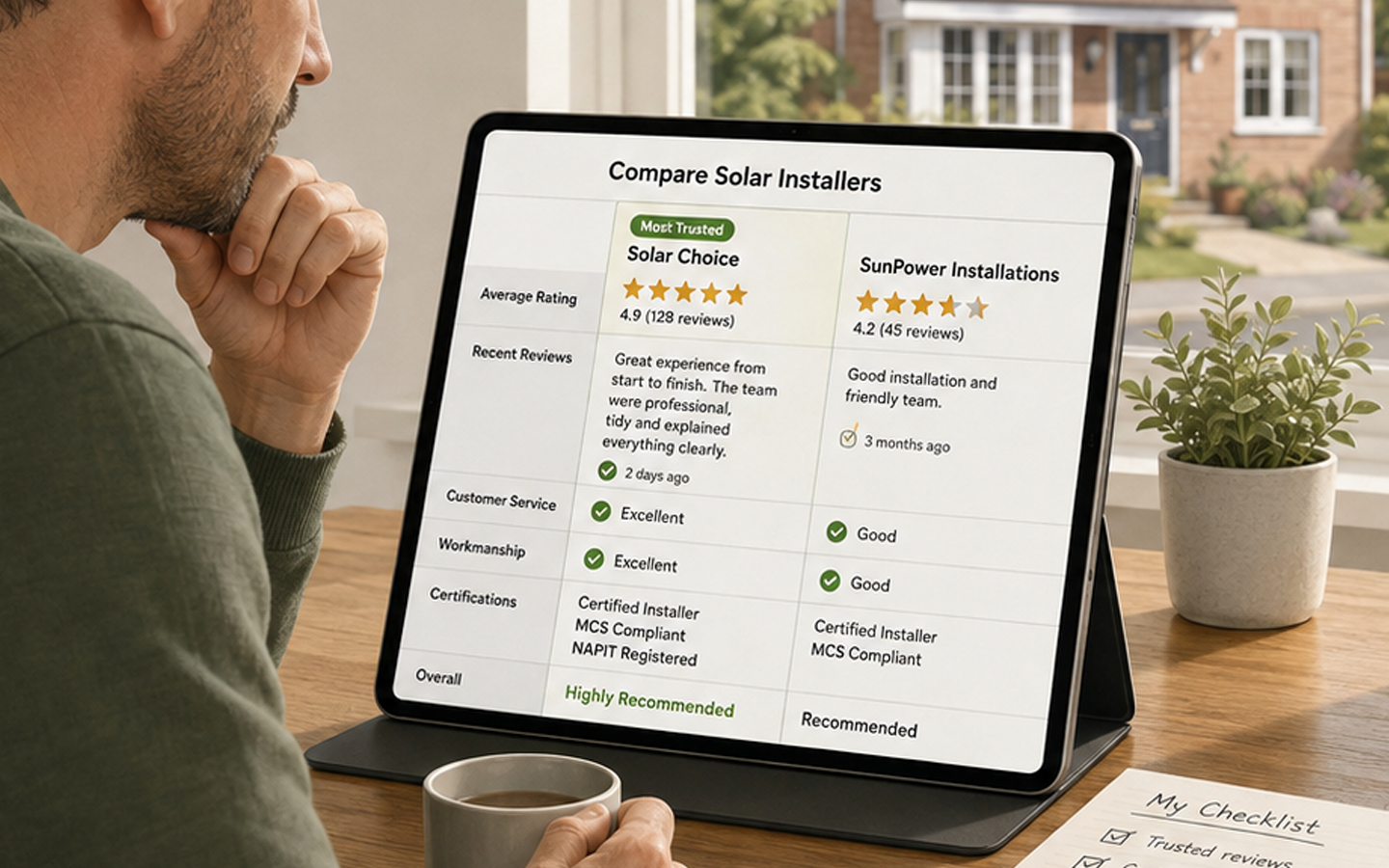
They check reviews, look at completed project photos, scan for recognisable credentials, and assess whether a business feels trustworthy.
According to recent consumer research, over 80% of UK homeowners read online reviews before making a purchasing decision for home improvement services.
For solar installations, which involve significant financial investment, that research process is even more thorough.
Homeowners want reassurance. They want to see that other people in their area have used your service and had a positive experience.
They want to know you are certified, insured, and established.
A business that ticks those boxes clearly, both on its website and across review platforms, will always win more enquiries than one that leaves those questions unanswered.
How local search rankings affect your enquiry volume
Appearing in the top results for searches like "solar panel installers near me" or "MCS-certified solar installer UK" can dramatically increase the number of inbound leads you receive without any additional advertising spend.
Google's local pack, which shows the top three business listings on a map, captures a large share of click-through traffic for location-based searches. If your business is not in that top three, you are likely missing a significant portion of available enquiries in your area.
The good news is that local search rankings are highly achievable for small and medium-sized solar businesses.
Unlike competing for national keywords, local SEO focuses on relevance, proximity, and reputation. These are areas where an established local installer can genuinely outperform larger national brands.
What Does It Mean to Be MCS-Certified and Why Does It Matter to Homeowners?
MCS certification, issued by the Microgeneration Certification Scheme, is the UK's recognised quality standard for small-scale renewable energy installations. For homeowners, it is not just a badge.
It is a requirement for accessing government incentives such as the Smart Export Guarantee (SEG), which pays households for surplus energy exported to the grid.
Choosing an MCS-certified solar installer is therefore a financial necessity, not just a preference.
Despite this, many installers treat their MCS status as a background detail rather than a frontline trust asset.
Bringing this credential to the forefront of your online presence can significantly change how homeowners perceive your business before they have even spoken to you.
How to communicate your MCS certification online effectively
Displaying your MCS credentials clearly on your website homepage, your Google Business Profile, and review platforms sends an immediate signal to prospective customers.
It tells them that your work meets a nationally recognised standard and that they will be eligible for SEG payments after installation. That practical benefit is something homeowners actively care about.
Beyond simply displaying the logo, consider writing a short explanation on your website of what MCS certification means and why it protects the homeowner. Use plain language and focus on the benefit to them.
This kind of content also helps your website rank for searches related to MCS accreditation, bringing in homeowners who are already educated buyers.
Building Homeowner Trust Without a Large Marketing Budget
Trust is not built through expensive advertising campaigns. It is built through consistency, transparency, and social proof.
For a local solar installation business, this means showing up in the right places, saying the right things, and making it easy for prospective customers to feel confident before they contact you.
The trust-building strategies for solar businesses that work best are often the simplest and most affordable.
Small installers sometimes assume that bigger companies with larger marketing budgets will always win more customers.
In reality, homeowners often prefer a local, personal business with strong reviews over a faceless national brand. The key is making sure your credibility is visible, not hidden in the background.
The role of online reviews in converting solar enquiries
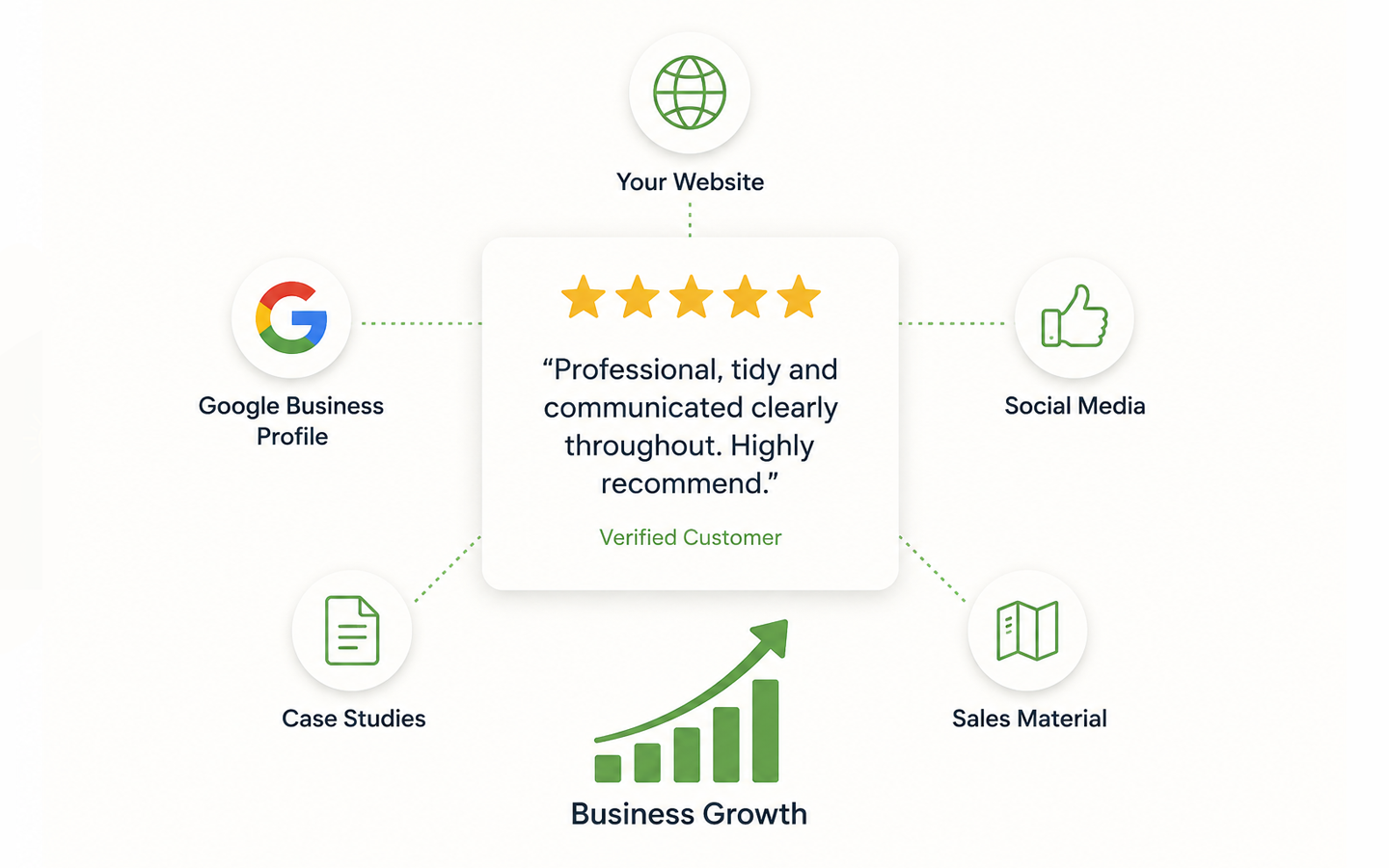
A steady stream of genuine, recent reviews on Google and Trustpilot significantly increases the likelihood that a homeowner will choose your business over a competitor with fewer or older testimonials.
Reviews are not just social proof. They are a ranking factor for local search. Businesses with more recent, positive reviews tend to appear higher in Google's local results.
The most effective approach is to make requesting a review a standard part of your post-installation process.
Send a message to the homeowner within a day or two of completing the job, thank them, and include a direct link to your Google review page.
This simple step, repeated consistently, builds a review profile that works for your business around the clock.
Case studies and real results as trust-building tools
Showcasing completed installations with before-and-after details, system performance data, and homeowner quotes gives prospective customers the confidence to make contact.
A well-written case study answers the questions a homeowner is already asking:
- How much did it cost?
- How long did it take?
- What are the savings like?
If you can answer those questions through real examples, you reduce the hesitation that stops people from enquiring.
You do not need a professional photographer or a copywriter to create effective case studies.
A few photos from your phone, some honest numbers, and a short quote from the customer can be enough to make a strong impression.
How to Optimise Your Google Business Profile as a Solar Installer
For local solar businesses, the Google Business Profile is often the first point of contact a homeowner has with your brand.
An incomplete or poorly managed profile can cost you significant enquiry volume each month.
An optimised profile, on the other hand, can bring in a consistent flow of local leads without any paid advertising. This section walks through the key steps that every MCS-certified solar installer should prioritise.
Google uses your Business Profile to decide whether to show your business in local search results and in the local map pack.
The more complete and active your profile, the more likely Google is to consider it relevant for local homeowners searching for solar installation services.
Choosing the right service categories and descriptions
Selecting accurate and relevant primary and secondary categories is one of the most important steps in optimising your Google Business Profile.
For a solar installer, your primary category should reflect solar panel installation.
Secondary categories can include battery storage installation or energy efficiency services, depending on what you offer.
Your business description should be written clearly and include the services you provide, the areas you cover, and your MCS-certified status. Keep it factual, specific, and easy to read.
Avoid vague language and focus on what makes your business the right choice for a local homeowner.
Keeping your service areas up to date also tells Google exactly where you are active, which strengthens your relevance for location-based searches.

Using photos to strengthen your profile
Regularly uploading photos of recent installations builds credibility and makes your profile look active and professional. Google rewards regularly updated profiles with better visibility.
Aim to add at least two or three new photos each month. These do not need to be studio-quality images.
Clean, clear photos of completed rooftop installations, battery setups, or even your team at work all contribute positively.
Growing Your Solar Business Without Hiring Additional Staff
One of the most common concerns among solar installation business owners is how to handle more leads without overstretching their current team.
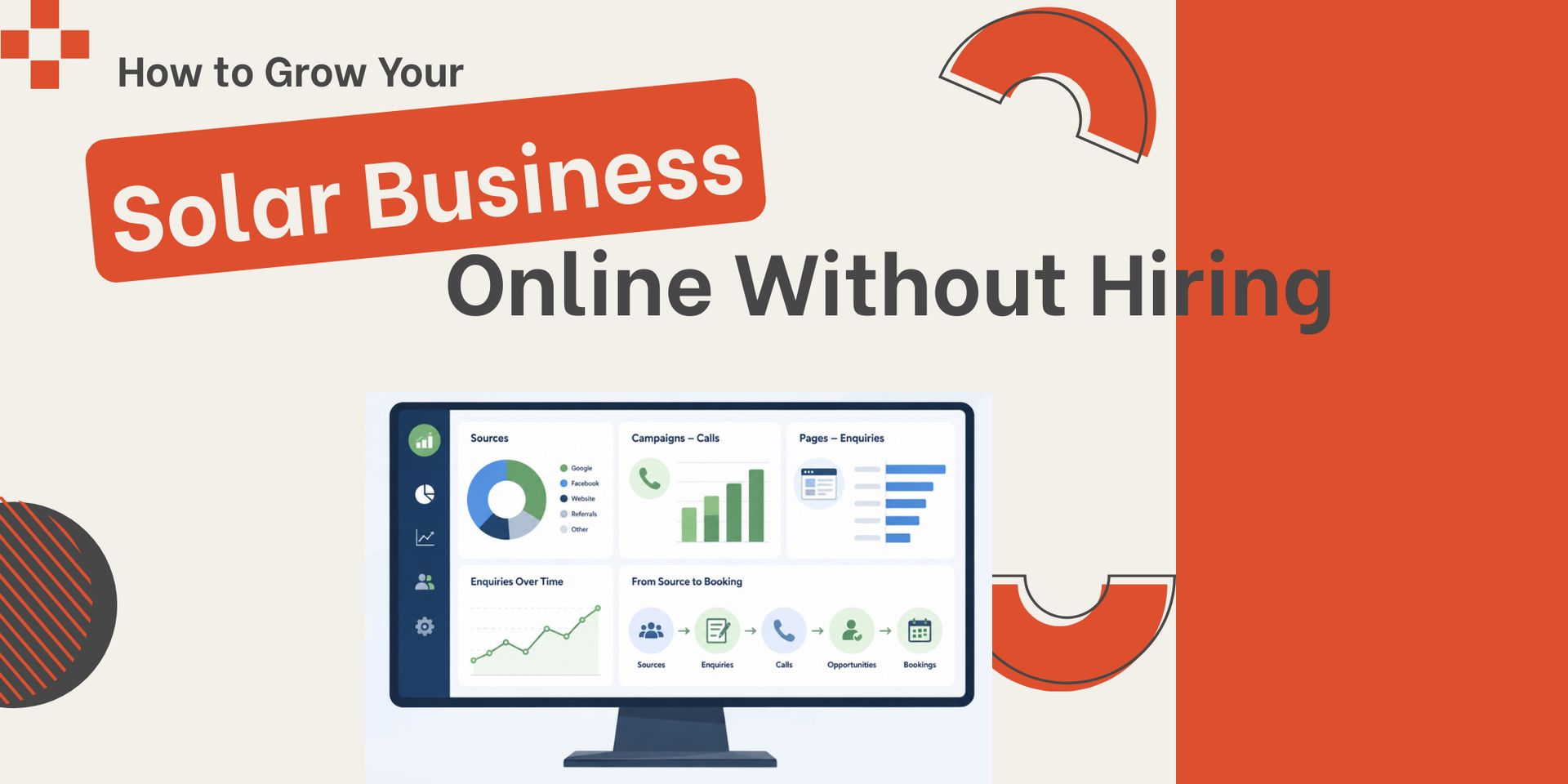
The good news is that smart digital strategies and streamlined processes can support real growth without requiring you to bring on new staff straight away. Understanding Solar Installer Growth System can help you see what a structured approach to online visibility looks like in practice.
Many solar businesses are already leaving growth on the table because their processes for managing enquiries, following up with prospects, and requesting reviews are inconsistent.
Tightening up these processes can have a bigger impact on your booking rate than any advertising campaign.
Automating follow-up and enquiry management
Simple automation tools can save several hours each week while keeping your pipeline active.
When a new enquiry comes in through your website or Google Business Profile, an automated response that acknowledges the message and sets expectations about when they will hear back makes an immediate positive impression.
Many homeowners contact multiple installers at once. Being the first to respond, even with an automated message, puts you ahead of competitors who reply days later.
You can also set up automated review requests that send a message to the homeowner a few days after installation.
Tools like Google's own business messaging features, or simple CRM platforms, make this straightforward and low-cost. The key is to build these steps into your standard process so they happen every time, without relying on memory.
Focusing on higher-margin jobs to improve profitability
Attracting customers who are interested in battery storage alongside solar panels can significantly improve your average job value without increasing your workload.
A battery installation added to a solar job typically adds thousands of pounds to the contract value while requiring only a modest amount of additional time on site. Positioning your business clearly as a solar and battery installation specialist, rather than a solar-only installer, can shift the type of enquiry you receive.
This is partly about how you describe your services online and partly about the content you produce.
If your website and Google profile focus heavily on battery storage benefits, you are more likely to attract homeowners who are already considering the full system.
These tend to be more informed buyers who are further along in their decision-making, which often means shorter sales cycles as well.
What a Strong Online Reputation Does for Your Solar Business Long-Term
Reputation compounds over time. Installers who invest consistently in their online presence and review profiles build a self-reinforcing cycle of trust, visibility, and bookings.
A business with 150 genuine reviews and an active Google profile will attract more enquiries than one with 20 reviews and a profile that has not been updated in a year, even if the quality of the actual installation work is identical.
The long-term commercial impact of reputation management for UK solar businesses is significant.
As the UK government continues to support renewable energy adoption, and as more homeowners look to install solar panels to offset rising energy costs, the pool of available customers will keep growing.
The installers who have built strong online reputations will capture a disproportionate share of that demand.

How visibility improvements translate into confirmed bookings
Moving from page two to the top of local search results, combined with a strong review profile, can double or even triple monthly enquiry volumes for an established installer.
This is not an exaggeration. When you consider that most homeowners do not look beyond the first page of results, and that the top three local listings capture the majority of clicks, the difference between ranking fifth and ranking first is enormous in practical terms.
Visibility improvements also tend to bring in better-quality leads.
Homeowners who find you through organic local search are often further along in their research and more ready to commit than those reached through cold advertising. This means your conversion rate from enquiry to booking tends to improve alongside the volume increase.
Is Your Solar Business Ready to Attract More Local Homeowners?
Take a moment to honestly assess where your business stands right now.
- Do you appear in the local map pack when someone in your area searches for a solar installer?
- Is your Google Business Profile complete, regularly updated, and stocked with recent reviews?
- Does your website clearly communicate your MCS-certified status and the areas you serve?
If the answer to any of these questions is no, there is likely a measurable gap between the enquiries you are currently receiving and the enquiries you could be receiving.
The solar market across the UK is growing, and homeowner demand for certified, trustworthy installers is only increasing.
The businesses that invest in their online presence now will be the ones that benefit most as that demand rises.
If you are ready to understand exactly where your visibility gaps are and what to do about them, get a tailored visibility assessment for your solar business and take the first step towards consistent, sustainable growth.
Frequently Asked Questions
What does MCS certification mean for a solar installation business?
MCS certification, provided by the Microgeneration Certification Scheme, confirms that your business meets the UK's recognised quality and safety standards for small-scale renewable energy installations. For homeowners, it means their installation is eligible for the Smart Export Guarantee, which pays them for surplus energy returned to the grid. For your business, it is a credibility signal that sets you apart from uncertified competitors.
How can a solar installer improve their Google ranking without paid advertising?
The most effective steps are optimising your Google Business Profile, building a consistent stream of recent reviews, ensuring your website clearly describes your services and service areas, and creating useful content that answers the questions homeowners are searching for. These organic strategies, applied consistently over several months, can significantly improve your local search ranking without any advertising spend.
Why do homeowners choose one solar installer over another?
Homeowners typically choose based on trust signals: recent reviews, visible credentials like MCS certification, clear communication, a professional online presence, and evidence of completed work in their local area. Price plays a role, but it is rarely the deciding factor when a homeowner feels confident in one installer and uncertain about another.
How many online reviews does a solar business need to build trust?
There is no fixed number, but businesses with fewer than 10 reviews often struggle to be taken seriously by prospective customers. Aiming for at least 25 to 30 genuine reviews is a reasonable starting point. After that, the focus should be on keeping them recent, as a business with 15 reviews from the past six months will often be trusted more than one with 50 reviews from three years ago.
What is the difference between local SEO and general SEO for solar companies?
Local SEO focuses on helping your business appear in location-based searches, such as "solar installer in Bristol" or "MCS-certified solar installer near me." It involves optimising your Google Business Profile, building local citations, and earning reviews. General SEO focuses on ranking for broader keywords across any location. For most solar installation businesses, local SEO delivers a much stronger return because the customers you want are searching locally.
How long does it take to see results from improving online visibility?
Most solar businesses begin to see measurable improvements in their Google Business Profile visibility and review-driven enquiries within 60 to 90 days of making consistent improvements. Organic website ranking improvements typically take three to six months to show clearly. The timeline depends on how competitive your local area is and how consistently you apply the strategies.
Can a small solar installation company compete with larger national brands online?
Yes, and often very effectively. Local SEO levels the playing field because it rewards relevance and local reputation, not just domain authority or marketing budget. A small installer with 80 recent reviews, an active Google Business Profile, and a well-structured website can outrank a national brand in local search results. Homeowners also tend to prefer a local, personal business when making a significant investment like solar panel installation.
Recent Posts