Andrew Hurrell • November 23, 2026
Why Small Business Websites Fail to Convert Visitors
Discover why small business websites fail to convert visitors and learn simple, proven fixes to turn more browsers into paying customers and enquiries.
If your small business website is getting visitors but not generating enquiries, you are not alone. This is one of the most common frustrations we hear from local business owners across Essex, Basildon, Billericay, Brentwood, and beyond.
The website exists, it looks reasonable, and yet the phone stays quiet. The problem is rarely about traffic. It is almost always about conversion, and the good news is that most of the issues are very fixable.
What does "conversion" actually mean for a local business?
For a local business, a conversion is any moment a visitor takes the action you actually want them to take. That might be picking up the phone, filling in an enquiry form, booking an appointment, or requesting a quote.
It is not about page views or visitor numbers.
Those figures can look impressive while your business generates nothing from them.
Many small business owners put all their energy into getting people to the website, through social media, Google searches, or word of mouth referrals.
But if the website itself does not do its job, that effort is wasted.
Think of your website as a member of your sales team. It needs to greet visitors warmly, answer their questions clearly, and guide them towards getting in touch.
A website that fails to do that is not just unhelpful; it is actively costing you money.
The average small business website converting at 1 to 2% might sound low, but even that modest figure depends on everything working as it should. Many local business websites convert at well under 1%, which means 99 out of every 100 visitors leave without doing anything.
Understanding why that happens is the first step to changing it.
The most common reasons visitors leave without getting in touch
Most visitors leave a website without making contact because something gets in the way.
It might be a slow page that tests their patience, a homepage that does not explain what the business actually does, or a layout that makes it harder than it should be to find a phone number.
These are not dramatic failures. They are small friction points that quietly push people away, and they are exactly what makes a poor website so costly for a local business.
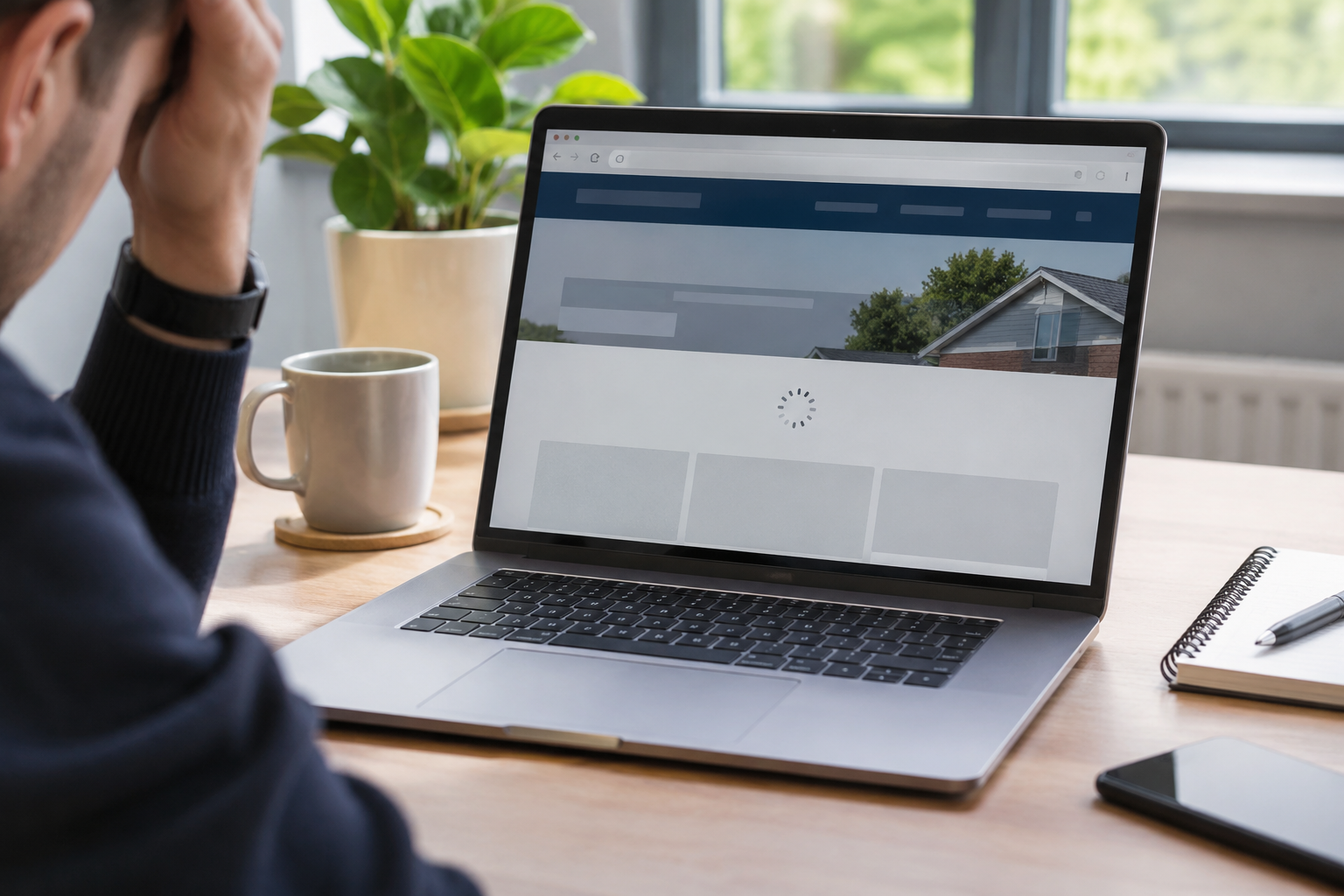
Slow load times are a major factor. Research from Google shows that if a page takes more than three seconds to load, more than half of mobile users will leave.
For a local trades business or service provider competing in a specific area, losing that many visitors before they have even seen your content is a serious problem.
Page speed is not just a technical detail; it directly affects whether people stay or go.
Unclear messaging is just as damaging. If a visitor lands on your homepage and cannot immediately tell what you do, where you operate, and why they should choose you over someone else, they will click back and try the next result. You have a very short window to make your value clear, and most small business websites miss it.
The absence of a visible, obvious call to action is another consistent issue. Many websites assume visitors will know what to do next. They will not. People need to be told clearly: call now, get a free quote, or book your visit today. Without that, even genuinely interested visitors will drift away without acting.
Is your homepage doing the heavy lifting?
Your homepage is usually the first page a visitor sees, and it needs to answer three questions within seconds: who you are, what you do, and why someone should choose you. If a visitor has to read through several paragraphs or scroll down to find the answers to those questions, you have already lost many of them.
A strong homepage gets straight to the point. The headline should state clearly what you offer and who you help. A short supporting sentence can add a little context, and then a clear call to action button should be visible without any scrolling.
This is not about being clever or creative with your language. It is about being immediately useful to the person who has just landed on your page.
Think about the last time you searched for a local service and clicked on a result. If the page did not quickly reassure you that this was the right business for your needs, you probably went back and tried someone else.
Your potential customers do exactly the same thing. Your homepage has one job: to make people feel confident enough to get in touch.
Are you making visitors work too hard to contact you?
If someone has to hunt for your phone number, they will not bother. Contact details should be visible at the top of every page, not tucked away in a footer or buried on a contact page that requires two clicks to reach. On mobile devices especially, a click-to-call button is essential.
Most people searching for a local service on their phone want to call you directly, and any friction in that process reduces the chance they will.
Enquiry forms should be short and simple. Asking for a name, email address, phone number, and a brief message is usually enough. Long forms with multiple required fields put people off. The easier you make it for someone to reach you, the more likely they are to do it.
Having a mobile-friendly website is no longer optional for local businesses; it is the baseline expectation of anyone searching on a smartphone.
Why trust signals matter more than you think
Most visitors arriving at a small business website do not know you yet. They are assessing whether you are credible, reliable, and worth their time before they pick up the phone.
Trust signals are the elements of your website that help answer that unspoken question: "Can I trust this business?"
Reviews and testimonials are among the most powerful trust signals you can include.
According to BrightLocal's 2025 Local Consumer Review Survey, 87% of consumers read online reviews for local businesses, and the majority say reviews influence whether they choose to contact a business.
Displaying genuine reviews on your website, particularly on service pages and your homepage, shows potential customers that real people have used your service and been happy with it.
This is why understanding the power of customer reviews is so valuable for any local business looking to grow.

Accreditations, trade body memberships, guarantees, and "about us" content that features real people also contribute to this sense of trust. A website that feels anonymous or generic makes people cautious.
One that shows the real business behind it, with a name, a face, and evidence of satisfied customers, does the opposite. In short, trust signals reduce the hesitation that stops people from picking up the phone.
Do your photos help or hurt your credibility?
The images on your website send a signal about your business before a visitor reads a single word. Generic stock photos of smiling people in hard hats or abstract office scenes tell visitors nothing about who you actually are. Worse, they can make your business feel impersonal and interchangeable with every other company using the same imagery.
Real photos of your team, your work, your premises, or your finished projects tell a much more compelling story. They show visitors that there are genuine people behind the business and give them a reason to feel confident.
A kitchen fitter showing photos of completed jobs, or a salon showing before-and-after images, gives potential customers exactly the kind of evidence they are looking for.
As we explain in our guide to why great photos make or break your website, authentic imagery is one of the quickest ways to build credibility with a visitor who does not yet know you.
How your website copy could be pushing people away
If your website copy sounds like it was written for a brochure rather than a real person with a problem to solve, it is likely working against you.
Vague phrases like "delivering excellence across all areas of our service portfolio" or "a passion for quality in everything we do" might sound professional, but they say nothing useful to a visitor who simply wants to know whether you can fix their leaking roof or design their garden.
Strong website copy speaks directly to the customer and the problem they are trying to solve. It uses plain, everyday language and focuses on outcomes. Instead of "we provide comprehensive drainage solutions," try "we fix blocked drains fast, usually on the same day."
One of those sentences tells a customer something useful. The other does not. If you want to understand how to write content that genuinely works for your business, our advice on how to produce copy that ranks is a useful starting point.
Good copy also needs to be scannable. Most visitors will not read every word on a page.
They will skim headings, bullet points, and the first sentence of each paragraph to decide whether the page is worth their time. Writing clearly, using short paragraphs, and breaking content up with subheadings helps people find what they need quickly and increases the chance they will stay long enough to get in touch.
Are you talking about yourself too much?
This is one of the most common mistakes on small business websites, and it is an easy one to make. It feels natural to explain your history, your qualifications, and your values.
But the visitor who has just landed on your page has one question in their mind: "Can this business help me?" Every paragraph that talks about your business without addressing their need is a missed opportunity to keep them engaged.
The shift is straightforward. Instead of writing "we have been trading for over 15 years and pride ourselves on our reputation," try "you get a trusted, experienced team that local customers have relied on for over 15 years."
The information is similar, but the focus is entirely different. One version is about you. The other is about the customer and what they gain. Reframing your copy around the customer's perspective, their problems, their goals, and their concerns, tends to produce a far more engaging and persuasive website.
The role of page structure in keeping visitors engaged
Even the best content will fail if the page is hard to read. Page structure is about making it as easy as possible for visitors to find the information they need and take the action you want them to take.
A well-structured page uses clear headings, plenty of white space, short paragraphs, and a logical flow that naturally guides the reader towards your call to action.
When visitors land on a cluttered or confusing page, they do not try harder to make sense of it.
They leave.
Contrast that with a page that leads them clearly through a problem, a solution, evidence that it works, and an easy next step. That kind of structure keeps people engaged and builds confidence.
There are practical techniques for doing this well, and if you want to go deeper on the subject, our guide on how to keep potential customers on your website covers the key principles in detail.
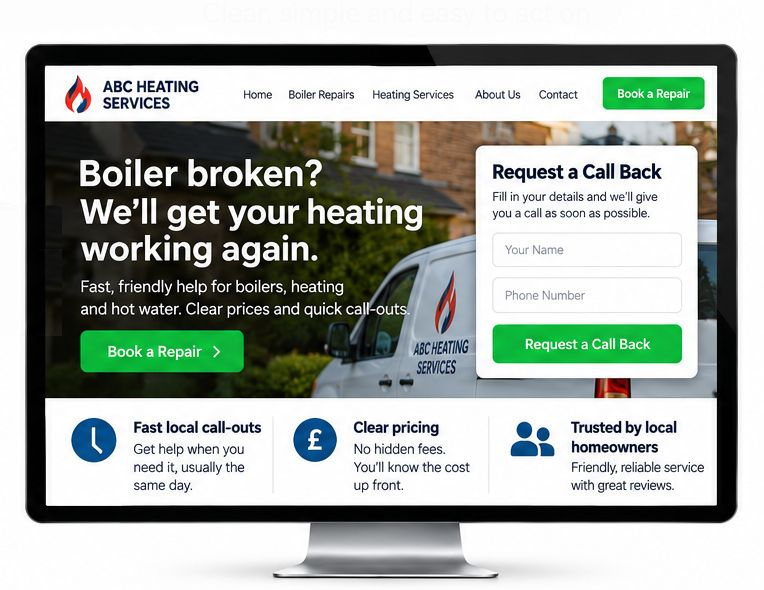
It is also worth thinking about how people actually read on screens. Research consistently shows that online readers scan in patterns, often looking at headings and the first few words of each paragraph before deciding whether to read further.
Writing with that behaviour in mind, front-loading the important information in each section and using clear, descriptive headings, makes a significant difference to how long people stay and how much of your content they actually absorb.
Why every service needs its own dedicated page
Cramming all of your services onto a single page is a common shortcut that costs local businesses in two ways.
First, it makes for a poor experience for visitors, who have to dig through a wall of content to find what is relevant to them. Second, it limits your visibility in search results, because Google struggles to rank a single page for multiple distinct services across different locations.
A dedicated page for each service allows you to speak directly to the person looking for that specific thing.
A plumbing company with separate pages for boiler installations, emergency callouts, and bathroom fitting can speak directly to the needs of each type of customer.
Each page can be optimised for the right keywords, include relevant images and testimonials, and make a specific case for why this business is the right choice for that job. The SEO and user experience benefits of this approach are explained in full in our piece on why every service deserves its own page.
What small changes can make the biggest difference to conversions?
Improving your website's ability to convert does not always require a full redesign. Several targeted changes can produce noticeable results relatively quickly.
The key is to focus on the elements that have the biggest influence on whether a visitor stays, builds confidence, and gets in touch.
Stronger headlines are one of the highest-impact changes you can make.
Your headline is the first thing most visitors read, and if it does not immediately communicate value or relevance, a large proportion of them will leave. Rewriting your homepage headline to clearly state who you help and what outcome you deliver is a small change with potentially significant results.
Clearer calls to action are equally important. Every page should have at least one clear, visible prompt telling visitors exactly what to do next. Whether that is "call us today for a free quote" or "book your free consultation," the instruction needs to be obvious and placed where visitors naturally reach it as they read through the page.
Placing social proof, such as a short testimonial or a review rating, close to your call to action also helps, as it provides reassurance at exactly the moment a visitor is deciding whether to act.
Page speed improvements, even modest ones, can also affect conversion rates meaningfully.
Compressing images, removing unused plugins, and choosing a reliable hosting provider are all practical steps that improve load times without requiring a complete rebuild. For a broader look at the factors that affect local search performance, our guide to the 5 local SEO secrets most business owners miss covers several areas worth addressing.
Is it time to get expert help with your website?
If you have read through this article and found yourself nodding along, thinking "yes, that is exactly the problem," the most honest advice we can give is this: many small business owners simply do not have the time or technical knowledge to fix these issues on their own.
Knowing what the problems are is one thing. Fixing them consistently, while also running a business, is another challenge entirely.
Get Customers Fast works with local businesses across Essex, including Basildon, Billericay, and Brentwood, as well as clients across the wider UK, to build and improve websites that genuinely convert visitors into customers.
The approach is fully done for you, which means you do not have to wrestle with page builders, write your own copy, or try to figure out why your contact form is not working. Everything is handled.
If your small business website is not converting visitors into enquiries, the issues outlined in this article are a good place to start. But if you would rather have someone who knows what they are doing take care of it for you, we are ready to help.
Frequently asked questions
Why is my website getting visitors but no enquiries?
The most common reasons are unclear messaging, no visible call to action, a lack of trust signals, or a slow page that causes visitors to leave before they engage. If your homepage does not immediately tell visitors who you are, what you do, and why they should choose you, many of them will leave without getting in touch. Start by reviewing those three things.
What is a good conversion rate for a small business website?
A conversion rate of 2 to 5% is considered reasonable for a local business website, though well-optimised websites in competitive service industries can achieve higher. If your website is converting at less than 1%, there are almost certainly structural or messaging issues worth addressing.
How do I know if my website is losing me customers?
If you are getting traffic but few or no enquiries, that is the clearest indicator. You can also check your Google Analytics data for high bounce rates, short average session times, and low click rates on your contact page. These metrics together paint a clear picture of where visitors are disengaging.
Does website design really affect whether people get in touch?
Yes, significantly. Research consistently shows that visitors form an impression of a website within a few seconds, and a poor design undermines trust before the visitor has read a single word. A cluttered layout, outdated styling, or a site that does not work properly on mobile can all prevent people from getting in touch, even if your service is excellent.
How many seconds does it take for a visitor to decide whether to stay on a website?
Studies suggest that most visitors form a first impression within 0.05 seconds, and the majority will decide whether to stay or leave within three to five seconds. That is the window in which your headline, your layout, and your page speed either keep them there or send them back to the search results.
What should every small business website include to convert visitors?
Every small business website should have a clear headline that states what you do and who you help, a visible phone number and call to action on the homepage, genuine customer reviews or testimonials, real photos of your work or team, and a fast loading speed that works properly on mobile devices.
Can improving my website copy really make a difference to sales?
Absolutely. Copy that speaks directly to the customer's problem, uses plain English, and leads clearly towards a call to action consistently outperforms vague or business-focused writing. Small changes to headlines and button text alone have been shown to increase enquiry rates meaningfully. If your current copy focuses mostly on your business rather than your customer's needs, rewriting it in a more customer-focused way is one of the highest-return improvements you can make.
Marketing Made Simpler - You’re Not On Your Own
More Customers. Bigger Wins. Better Business.