Andrew Hurrell • October 12, 2026
How to Turn Your Website Into a Customer-Winning Machine
Practical tips on copy, trust signals, local SEO, and calls to action for small businesses
If you've ever wondered how to get more customers from your website, you're not alone. Most small business owners have a website, but very few have one that actually brings in regular enquiries.
The good news is that turning your site into a genuine customer-winning tool does not require a full redesign or a big budget. It requires the right approach.
In short: a website wins customers when it loads fast, earns trust quickly, speaks clearly to the right people, and makes it easy for them to get in touch.
Every section of this guide breaks down exactly how to make that happen for your local business.
Why Most Small Business Websites Fail to Convert
Most local business websites have one thing in common: they attract visitors but do nothing with them. A business owner spends time and money getting people to the site, and then those visitors leave without ever making contact.
That gap between traffic and actual enquiries is where the real problem lives.
The reason this happens is usually not bad design. It is a lack of intention. A site that looks nice but does not guide visitors towards a clear next step will not convert. Design is just the wrapper.
What matters is whether the site is built with the customer's journey in mind, from the moment they land to the moment they pick up the phone or fill in a form.
Small businesses in areas like Basildon, Billericay, and Brentwood face particularly strong local competition online.
If your website is not doing the work of converting visitors, a competitor's site likely is. Understanding why your site is not performing is the first step to fixing it.
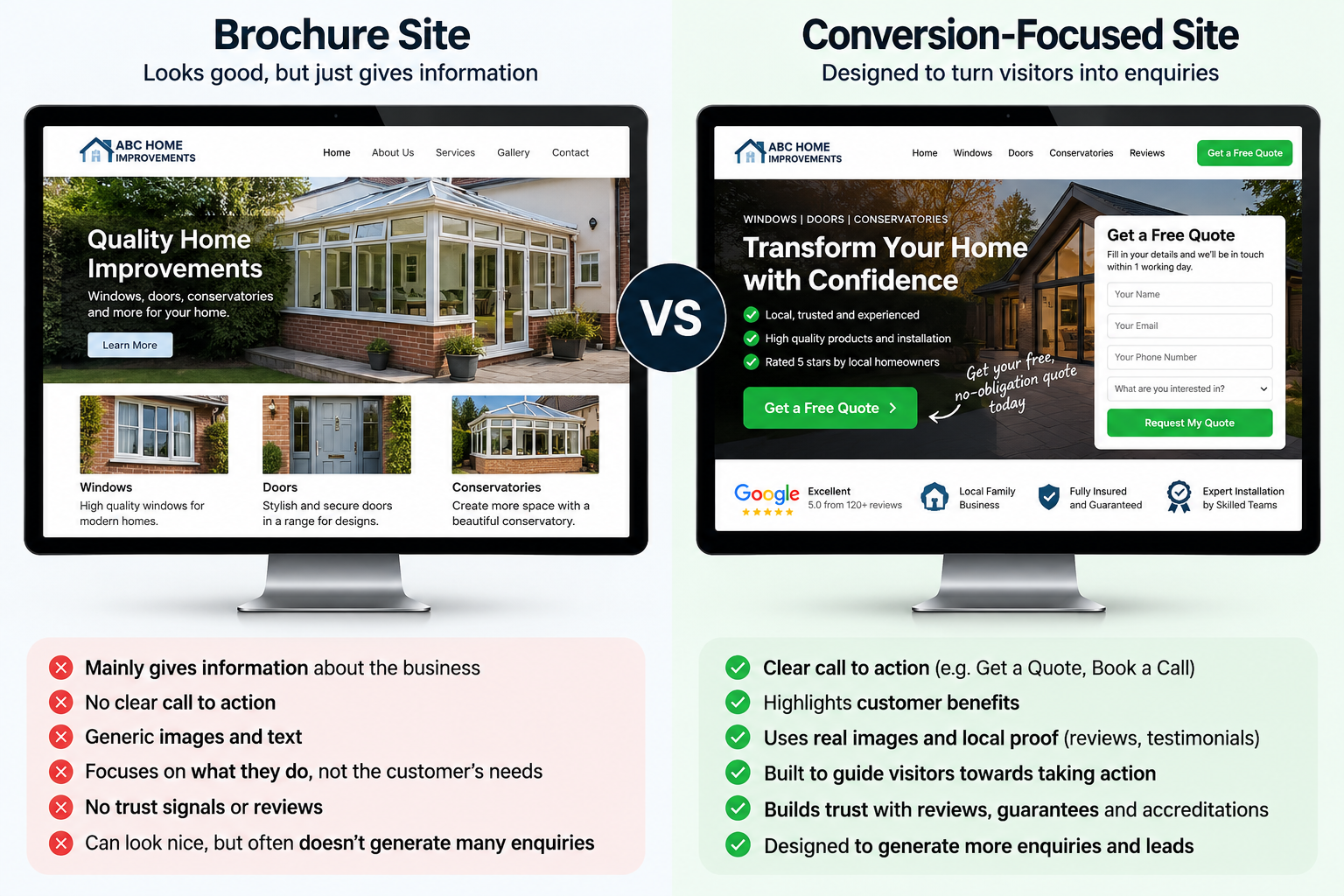
The difference between a brochure site and a conversion-focused site
A brochure site tells people what you do. It lists your services, maybe shows a few photos, and has a contact page buried in the menu. It exists to inform.
A conversion-focused site, on the other hand, is built to make people act. It answers questions, removes doubts, and leads visitors naturally towards getting in touch.
The distinction matters most for local service businesses. Someone searching for a plumber in Basildon or a landscaper in Brentwood is not browsing.
They have a problem and they want someone to fix it.
A brochure site makes them work to find out if you're the right fit. A conversion-focused site makes it obvious within seconds.
Think of it this way: your website should do the job of your best salesperson.
It should answer the right questions, handle common objections, and make the next step feel easy and obvious. If it is not doing that, it is costing you customers every single day.
What Do Visitors Actually Want When They Land on Your Site?
When a local customer lands on your website, they are usually already in buying mode. They have searched for a service near them, clicked your link, and now they need to make a quick decision about whether you're worth their time.
What they want is simple: reassurance that you can help them, that you are trustworthy, and that getting in touch will be easy.
According to BrightLocal's Local Consumer Review Survey, 98% of people used the internet to find local businesses in 2023, and that figure has only grown since. These are people with real intent.
They are not casually browsing.
They want answers fast, and if your site does not give those answers quickly, they will go straight back to Google and click the next result.
Understanding this mindset is the foundation of good local business website optimisation. Your job is not to impress visitors with fancy design.
Your job is to show them, as quickly as possible, that you understand their problem and that you are the right person to solve it.
Speed, clarity, and trust: the three non-negotiables
If your site loads slowly, people leave. Research from Google shows that 53% of mobile users will abandon a page that takes more than three seconds to load.
For a local business, that means losing potential customers before they have even seen what you offer.
Clarity is the second non-negotiable. Visitors should be able to tell within five seconds what you do, who you serve, and what they should do next.
If your homepage is cluttered, vague, or hard to navigate, you are creating friction that pushes people away.
Trust is the third. A website that looks outdated, has no reviews, and hides contact information will make people uneasy.
Local customers in particular want to feel confident before they pick up the phone. Every element of your site should help them feel safe choosing you.
If you want to understand more about what might be putting visitors off, take a look at why your website might be driving customers away.
How to Write Words That Actually Win Customers
The words on your website matter more than almost anything else. You could have a beautiful site, but if the copy does not connect with your visitors, they will not get in touch.
Good website copy does three things: it grabs attention, explains what you offer in plain language, and gives people a clear reason to act.
Most small business websites make the mistake of writing about themselves rather than writing for their customers.
They list qualifications, describe their history, and use technical terms that mean little to the average person searching for help.
The result is copy that sounds professional but feels cold and disconnected.
The businesses that get more enquiries from their websites are the ones that write like they talk.
They use simple words, short sentences, and language that mirrors what their customers actually say. Learning how important is good copy for your website is one of the most valuable things a local business owner can do.
Using the language your customers already use
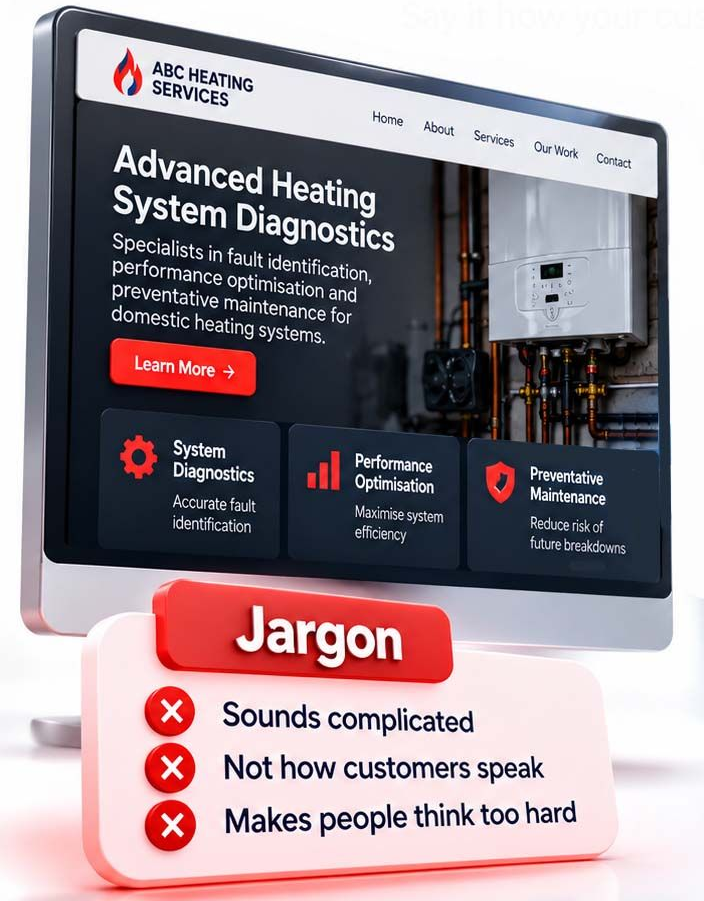
One of the most effective ways to improve your website copy is to stop using the words you would use and start using the words your customers use.
A heating engineer might talk about "system diagnostics" but their customer just wants to know if you can fix their boiler before it gets cold.
The customer's version is always the one that converts.
A good way to find the right language is to look at your reviews, your enquiry messages, and the questions people ask when they first contact you.
That is the raw material for copy that resonates.
When people read your website and think "this is exactly what I was looking for," it is almost always because the words mirror how they think about their problem.
For local businesses in Essex and across the UK, this is particularly important because the audience is practical and straightforward.
They want to know you can help, how soon you can do it, and roughly what it will cost. Write for that person and your site will perform far better.
Crafting calls to action that people actually click
A call to action is the prompt that tells your visitor what to do next. "Contact us" is technically a call to action, but it is so vague that most people ignore it.
Specific, benefit-led calls to action perform far better because they remove uncertainty and give the visitor a clear outcome to expect.
Instead of "contact us," try something like "Get a free quote today" or "Call us now for same-day availability." These phrases tell the visitor exactly what they will get by clicking, which makes the action feel worth taking.
The language should also match where the visitor is in their decision. Someone reading about your services for the first time needs a different prompt than someone who has already read your reviews and is ready to book.
The placement of your calls to action matters too.
They should appear at the top of the page, throughout the content, and at the bottom so that wherever a visitor decides they are ready, the next step is right there. For more on this, read the two lines that could double your website clicks.
Building Trust Before the Phone Even Rings
Local customers make trust decisions very quickly.
Before they call or fill in a form, they are scanning your website for signals that tell them whether you are reliable, professional, and worth their time and money.
If those signals are not there, the majority of visitors will quietly move on to someone else.
Trust signals come in several forms: customer reviews, professional photos, clear contact information, accreditations, and the overall feel of your site. Each one adds a small layer of credibility.
Together, they create the impression that you are a legitimate, established business that other people have trusted and been happy with.
For service businesses in particular, trust is everything. You are often asking people to let you into their home or hand over a significant amount of money. Your website needs to make them feel confident about that decision long before they ever speak to you.
How reviews and testimonials do the selling for you
Reviews are one of the most powerful things you can have on your website. A genuine five-star review from a real customer in your area does more to build confidence than almost any marketing message you could write yourself. People trust other people far more than they trust businesses.
The key is not just having reviews but displaying them in the right way.
Rather than hiding them on a dedicated testimonials page that nobody visits, weave them into your homepage, service pages, and anywhere else a visitor might have a moment of doubt.
A review placed just before a call to action, for example, can significantly increase the number of people who click.
Google reviews also carry extra weight because they appear directly in search results and on your Google Business Profile, which means they influence whether people even click through to your site in the first place.
To understand how to make reviews work harder for your business, read reviews: the hidden powerhouse behind service business growth.
Why great photos matter more than you think
Many small business websites either use no photos at all or rely on generic stock images.
Both are missed opportunities. Authentic, professional photos of you, your team, and your work create an immediate sense of credibility and connection that stock photos simply cannot replicate.
When a potential customer in Billericay or Brentwood sees a photo of a real person in a branded van, a finished job they are proud of, or a team they could picture showing up at their door, they start to feel comfortable.
It makes your business feel real and human in a way that words alone rarely achieve.
You do not need a professional photographer to get started, though good-quality images do make a significant difference.
A set of clear, well-lit photos taken on a modern phone can be far more effective than anything that looks overly polished and impersonal.
Find out more about why great photos make or break your website.
Is Your Website Actually Being Found on Google?
A well-built, conversion-focused website does you no good if nobody can find it. Getting found on Google, especially in local searches, is a challenge that many small businesses underestimate.
You might have the best plumbing service in Basildon, but if your website does not appear when someone searches "plumber in Basildon," you are invisible to most potential customers.
This is where local SEO comes in. Local SEO is the process of optimising your website and your online presence so that Google shows your business to people searching in your area.
It involves everything from the words on your pages to the way your Google Business Profile is set up. To get a proper grounding in this, it is worth reading what is local SEO and how does it work.
The good news for local businesses is that local SEO tends to be far less competitive than national SEO. You are not trying to outrank every business in the country.
You just need to be more visible than your local competitors, and that is often very achievable with the right approach.
Why every service needs its own dedicated page
One of the most common local SEO mistakes small businesses make is having a single services page that lists everything they offer in one place.
While this might seem tidy, it actually makes it much harder for Google to understand what you do and harder for potential customers to find the specific service they are looking for.
When you give each service its own dedicated page, you give Google a clear signal about what that page is about.
A page dedicated to "driveway installation in Brentwood" will rank far more effectively for that search than a generic services page that mentions driveways alongside ten other things.
It also gives your visitors a much better experience because the page they land on speaks directly to their specific need.
This approach is one of the most impactful changes a local service business can make to its website. For a full explanation of why it works, read why every service deserves its own page.
How to Keep Visitors on Your Site Long Enough to Enquire
Getting someone to your website is only half the challenge. Once they arrive, you have a short window to hold their attention.
If your site is hard to navigate, slow to load, or does not give people a reason to keep reading, they will leave without taking any action. This is known as bouncing, and it is one of the clearest signs that a website is underperforming.
The way to keep visitors engaged is to make every page easy to consume and genuinely useful.
That means clear headings, short paragraphs, relevant images, and obvious next steps.
It also means linking between pages so that visitors who want to know more can easily find it without having to search.
Internal links play a bigger role than most people realise.
When a visitor reads your homepage and sees a link to a relevant service page or a useful article, following that link keeps them on your site and deepens their understanding of what you offer. That extra time on site increases the chance they will make contact.
For more practical guidance on this, read how to keep potential customers on your website.
What Does a High-Converting Local Business Website Look Like?
A high-converting local business website is not necessarily the most beautiful or the most expensive. It is the one that makes it easiest for the right person to say yes.
Every element of the site works together with a single goal: to turn a visitor into an enquiry.
In practical terms, this means a clear, benefit-led headline on the homepage that tells visitors exactly who you help and what you do.
It means trust signals like reviews, photos, and accreditations placed strategically throughout the site.
It means a simple navigation structure that does not confuse people, and calls to action that appear regularly and feel natural rather than pushy.
The structure of the site matters too. A well-optimised local business website will have a strong homepage, individual service pages for each thing it offers, a clear about page that builds connection, and a contact page that makes getting in touch as frictionless as possible.
If you want to understand the most common pitfalls and how to sidestep them, take a look at common web design mistakes and how to avoid them.
Real examples from local businesses that got it right
It is one thing to read about what a good website should include. It is another to see it working in practice.
Local businesses across Essex and beyond have seen real, measurable improvements in the number of enquiries they receive after making focused changes to their websites.
Not wholesale redesigns in most cases, just the right changes applied in the right places.
A landscaping company in Basildon that added dedicated service pages and updated their homepage copy saw enquiries increase within weeks of the changes going live.
A family-run cleaning business in Brentwood that added authentic photos and moved their Google reviews to the homepage reported that more callers mentioned seeing them online than ever before.
These are not exceptional cases. They are what happens when a website is built with the customer in mind.
You can read more about results like these in the case studies section, which shows exactly what was done and what changed as a result.
Frequently Asked Questions
What makes a local business website convert visitors into customers?
A converting website combines fast loading speed, clear and benefit-led copy, visible trust signals like reviews and photos, and strong calls to action. Every element works together to make it easy for a visitor to feel confident and get in touch quickly.
How long does it take to improve a website's conversion rate?
Some changes, like updating your calls to action or adding reviews to your homepage, can show results within days. Larger improvements like new service pages or better copy may take a few weeks to reflect in enquiry numbers, but the changes tend to be lasting.
Do I need to redesign my entire website to get more enquiries?
Not always. In many cases, targeted improvements to your homepage, service pages, and calls to action can significantly increase enquiries without a full redesign. Start by identifying the biggest friction points on your current site and address those first.
How do Google reviews affect my website's ability to win customers?
Google reviews influence both search visibility and visitor confidence. A business with a strong review profile ranks more prominently in local search results and gives visitors a reason to trust you before they have even spoken to you. Displaying those reviews on your website amplifies their impact further.
What is the most important element of a small business website?
Clarity. Visitors need to understand what you do, who you help, and what to do next within seconds of landing on your site. If your homepage fails that test, everything else matters far less.
How do I know if my website is actually working for my business?
Track the number of enquiries coming through your contact form or phone, and use a free tool like Google Analytics to see how many people are visiting your site, how long they stay, and which pages they leave from. If lots of people visit but very few get in touch, your site is not converting and something needs to change.
Can a better website really help me compete with larger companies?
Yes. In local markets, a well-optimised website built around trust and clear communication can easily outperform a corporate competitor with a generic, impersonal site. Local customers want to feel like they are dealing with someone they can trust, and a well-crafted small business website can deliver that feeling far better than a large national brand.
Marketing Made Simpler - You’re Not On Your Own
More Customers. Bigger Wins. Better Business.